

Your Marketing Brain Deserves Sustainability, too: How to Turn One Blog Post Into Weeks of Social Content
September 23, 2026

Years ago, potential customers would type a few words into Google, scan ten blue links, and choose which page to click into. They could repeat the process until they found an answer or a brand that met their needs.
Now many of them simply go to an LLM and ask a full question instead. “Who are the best water treatment companies for reverse osmosis near me?” “Can you recommend the best metal mesh supplier for industrial use?”. And ChatGPT, Gemini, Perplexity, Claude, or Google’s AI Mode gives them an answer, often with a short list of businesses attached. If your brand is missing from those conversations, you may be losing out on opportunities to reach customers who are already looking for what you offer.
This potential opportunity is no longer small. Google reported at its I/O conference in May 2026 that AI Mode had passed one billion monthly users. So the question most business owners are asking us has changed from “Where do we rank?” to “Are we even visible in AI answers?”
The honest response is that AI visibility is harder to measure than a Google ranking, but it is not impossible. In this post, we will explore how to check your AI visibility and what to look for in the results.
What Is AI Visibility, and Why Does It Matter?
AI visibility, also known as LLM visibility or AI search visibility, refers to how often and how prominently your brand, products, services, or website appear in AI-generated answers.
When someone asks an AI platform a question, the response might mention your business by name, recommend one of your services, or cite a page on your website as a source. These are different ways your business can become visible during an AI-powered search.
For example, imagine someone asks ChatGPT: “What are the best digital marketing agencies for a small B2B business that wants more qualified leads?” The answer might recommend three agencies, explain what each does well, and link to supporting sources. If your business appears in that response, you have gained exposure to users who are actively considering potential providers. If a competitor appears instead, your business may be missing an opportunity.
Essentially, AI visibility tracking helps you understand how your brand is represented in AI search compared with your competitors.
Showing Up in AI Answers: Mentions vs. Citations vs. Recommendations
Before you start reviewing your AI visibility data, there are three signals you need to understand:
- Brand mentions: Here, the LLM names your business or product in its answer, with or without a link. This signal builds brand awareness and recognition.
- Citations: A citation occurs when the LLM uses a page from your website as a source and links to it. This signal can drive referral traffic.
- Recommendations: Being recommended means that the LLM actively suggested your business as a suitable option for the user’s needs. This may influence a buying decision.
These signals overlap, but they are not interchangeable. An AI platform can mention your brand without linking to your website. It can also cite a page from your website without recommending your business directly. When you check your visibility, you want to know which of these you are getting, not just whether your name appears.
How to Check Whether Your Website Appears in AI Answers
1. Ask AI Platforms the Questions Your Customers Ask
The simplest free test is to ask the AI tools the kinds of questions someone would ask when researching your products or services.
- Write down 10 to 15 real customer questions. Take them from sales calls, enquiry forms, and the things your team explains every week. Include a mix: “best [service] in [city]”, “[your service] vs [alternative]”, “how much does [service] cost”, and a direct question about your brand (“What is [Your Business] known for?”).
- Run them across the platforms your potential customers might use, including Google AI Overviews and AI Mode, ChatGPT, Claude, Perplexity, and Gemini. If possible, run them in a fresh temporary chat each time to reduce the influence of previous conversation context and saved preferences.
- Record what you see. Were you mentioned, cited, or recommended? Which competitors appeared? Which websites did the AI link to? Was anything it said about you wrong?
You can begin with a small set of important questions. The aim is to identify patterns, not to test every possible variation of a search.
However, it’s important to keep in mind that AI answers are not fixed in the way search rankings mostly are. In research published in early 2026, SparkToro and Gumshoe.ai ran 12 recommendation prompts through ChatGPT, Claude, and Google’s AI close to 3,000 times. They found that ChatGPT and Google’s AI had less than a 1-in-100 chance of getting the same list of brands twice. The order of recommendations varied even more. These findings come from a specific study, not every AI platform or type of prompt, but they show why a single response is a weak basis for judging visibility.
So a single spot check tells you whether your brand appeared in that particular response. It cannot tell you how often you appear, and it certainly cannot tell you your “position”.
2. Monitor Your Presence With an AI Visibility Tool
Manual searches are a useful starting point, but checking responses one by one becomes difficult when you want to compare platforms, competitors, topics, and changes over time. This is where dedicated AI visibility tools become useful.
Tools such as Semrush, Peec AI, and Profound provide reports that help businesses investigate how their brands appear in AI-generated answers. Depending on the tool, plan, and supported platforms, reports may include tracked prompts, brand mentions, sentiment, cited pages, visibility trends, competitor comparisons, and share-of-voice estimates. You can use these tools to build a more organized view of where you appear and where opportunities may exist.
A useful starting point is to investigate:
- Overall AI visibility: How frequently does your brand appear in the tracked answers?
- Platform-level visibility: Does your business appear across several AI platforms, or is its presence concentrated in one?
- Prompt-level visibility: Which questions trigger a mention or citation of your brand?
- Competitor visibility: Which competing businesses appear when yours does not?
- Source pages: Which pages on your website, if any, are cited in the answers?
The metrics and coverage available will depend on the tool, its subscription, and the platforms it tracks. Regardless of the tool, its data should be treated as a directional signal rather than an absolute measure. For instance, a visibility score could serve as a benchmark for the tool’s measured dataset, not a complete count of every AI conversation in which your business could appear.
Also, rather than fixating on a single set of data, the real value comes from repetition. Run multiple prompts repeatedly and compare the results month over month. Repeated testing can help you measure something as changeable as an AI answer with a little more confidence.
The prompts you track have to reflect how your customers actually ask questions, the competitor set has to be realistic, and the numbers need context before they turn into decisions. That is the part we handle for our clients. If you’re not sure what to track or how, reach out to us, and we’ll help you identify the right prompts, competitors, and metrics for tracking your AI search visibility.
3. Check Google Search Console and Your Google Analytics
Before we get into the following analytics tools, please note that they can help you understand the traffic side of AI visibility, but they do not provide the full picture.
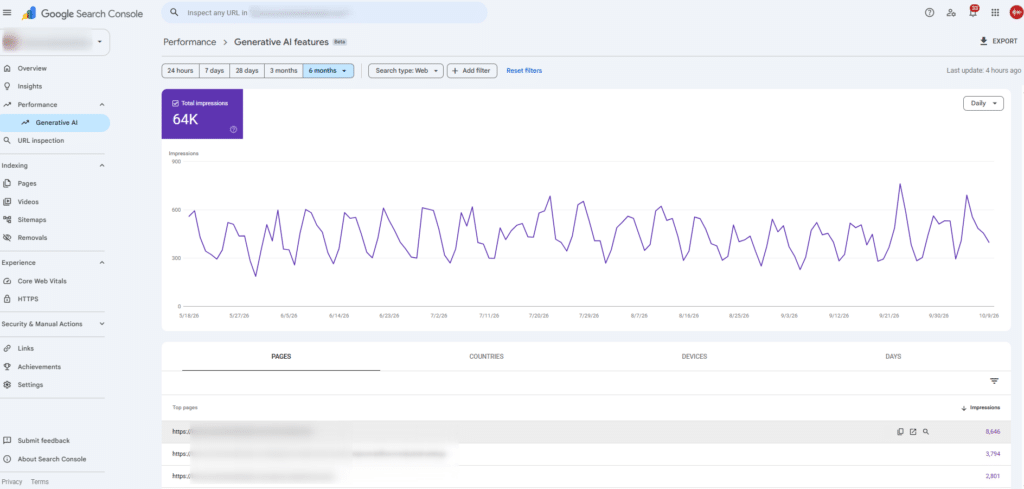
- Google Search Console: On June 3, 2026, Google launched Search Generative AI performance reports in Search Console, and by August 31, 2026, they had rolled out to all sites. The Search report shows impressions for pages appearing in Google AI Overviews and AI Mode, while a separate Discover report covers generative AI features in Google Discover. You can use these reports to review page performance and trends over time, with country-level data and device breakdowns available for Search. The reports currently focus on impressions rather than providing a full set of click and query data for these AI features. They also cover Google’s own experiences, not your brand’s visibility across ChatGPT, Claude, Perplexity, or other AI platforms. As a result, the standard report may not provide a complete, standalone view of your brand’s visibility across all AI platforms for now.
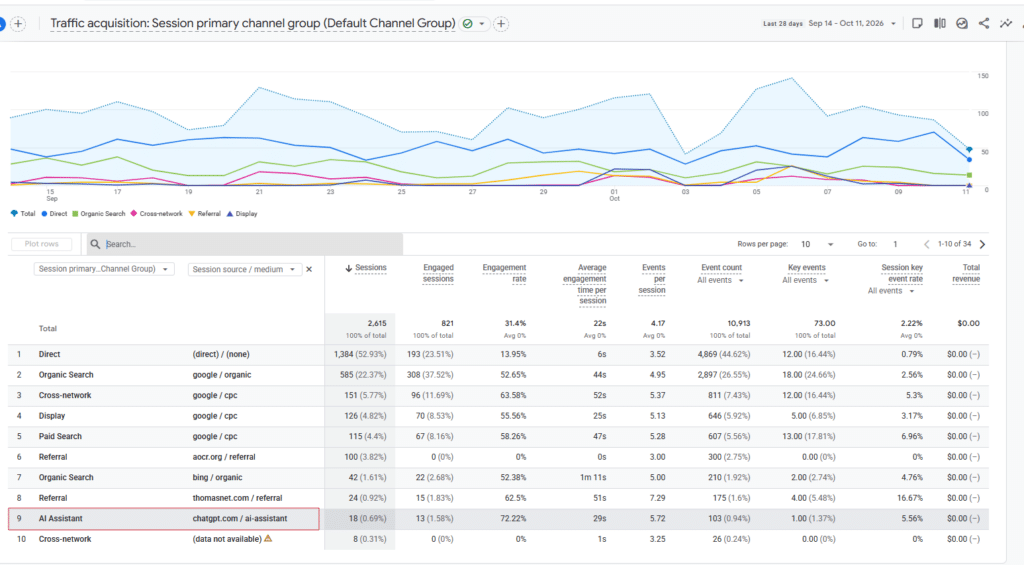
- Google Analytics 4 (GA4): In May 2026, GA4 added an AI Assistant channel for traffic from supported AI assistants, such as ChatGPT, Gemini, DeepSeek, Copilot, and Grok. However, traffic originating from AI Overviews and AI Mode is categorized under Organic Search. Also, some AI platforms, such as Perplexity, may still be filed under Referral or even as Direct traffic if the referrer headers are stripped. Additionally, this traffic acquisition data only captures part of the story. Someone might see your company recommended in an AI answer, remember your name, and visit your website later through Google or by typing your URL directly. That journey may not be attributed to the original AI interaction. So, it’s important to use GA4 alongside AI visibility tools and Search Console rather than treating any one source as a complete picture.
What to pay attention to when you check
Whether you are doing a manual check or reviewing a tool report, these are the signals that matter.
- Accuracy before anything else: Read what the AI says about your business. Outdated prices, services you no longer offer, the wrong service area, or an old address are common, and they matter more than whether you were mentioned. A confident wrong answer can cost you an enquiry.
- Mentioned versus cited: If AI tools mention your brand but don’t link to your website, they may be drawing on directories, review platforms, and other third-party sources. If they cite your website, you know your content is being used as a source in those responses. Looking at both signals helps you understand how your brand appears in AI answers and whether your website is part of the information supporting those answers.
- Who appears instead of you: Note every competitor that comes up. If the same two or three names appear repeatedly across platforms and prompts, they may have stronger visibility for those particular needs. That tells you more about your real competitive set than a keyword report.
- The sources behind the answer: Look at which websites the AI links to when it talks about your category. Industry directories, comparison articles, authoritative websites, and review sites often do more to shape AI answers than a business’s own homepage. If you are absent from those sources, that is often where the work starts.
- Which of your pages get used: As I mentioned earlier, AI visibility tools can show which URLs are cited in the AI responses they track. The cited page could be a detailed guide or FAQ page, rather than the service page you would expect. This can help you identify the types of content cited in the responses you track.
- Sentiment, tone, and framing: Being mentioned as “a budget option with mixed reviews” is not the same as being described as a trusted local specialist. Pay attention to the adjectives.
- Trends, not snapshots: Because answers vary run to run, judge visibility by how often you appear across many prompts over time. Be cautious of reports that present a single AI response as a fixed ranking position.
- Whether visibility turns into visits and enquiries: Review conversions attributed to the AI Assistant channel in GA4. A modest amount of AI traffic that converts well is worth more than a high visibility score that generates no leads. However, keep in mind that conversions from AI platforms may be misattributed in GA4. You can also add a “How did you hear about us?” field to your contact form, with AI platforms included as an option, to get a better idea of how potential leads find you.
What If Your Website Isn’t Appearing in AI Answers?
If your initial checks show little or no visibility, there is no need to assume that your website is failing.
Start by identifying what is actually missing. Is the AI unaware of your brand? Does it mention your business but fail to cite your website? Is it familiar with your company but not recommending it for the services you want to sell?
Each problem calls for a different investigation. For example:
- If your site is rarely cited, you might want to look into your crawl data, robots.txt file, and server log files to understand whether AI search crawlers can access your site.
- If your website is accessible but does not clearly explain your services, audience, expertise, or evidence of results, the priority may be improving the content itself.
- If your competitors are frequently mentioned and supported by relevant third-party sources, you may need to strengthen your business’s presence on relevant, authoritative third-party websites to build credibility.
These are possible explanations, but the exact reasons will depend on your data. While no single change guarantees that AI platforms will cite your website or recommend your brand, reviewing your data can help identify what needs to improve and where to focus your AI search optimization efforts.
Checking Your AI Visibility Is Only the First Step
An initial AI visibility check can tell you whether your business is appearing in the answers your potential customers receive. A deeper assessment helps explain where those appearances happen, which sources support them, how competitors compare, and where the gaps may be worth addressing.
That distinction matters because AI visibility is not simply a matter of getting your brand mentioned as often as possible. You want your business to appear in relevant conversations, be described accurately, and have credible information supporting the claims made about it.
At Fusion, we see AI search as an extension of the wider search and digital marketing picture. It needs to be considered alongside traditional SEO, website content, technical accessibility, brand authority, and the experience a visitor has when they reach your website.
If you want to understand how your business currently appears in AI answers, we can help you assess your AI search visibility, identify meaningful gaps, and develop a strategy for improving your presence.
Book a free strategy call with Fusion or email hello@fusioninbound.com to discuss your website’s visibility and what to do next.